
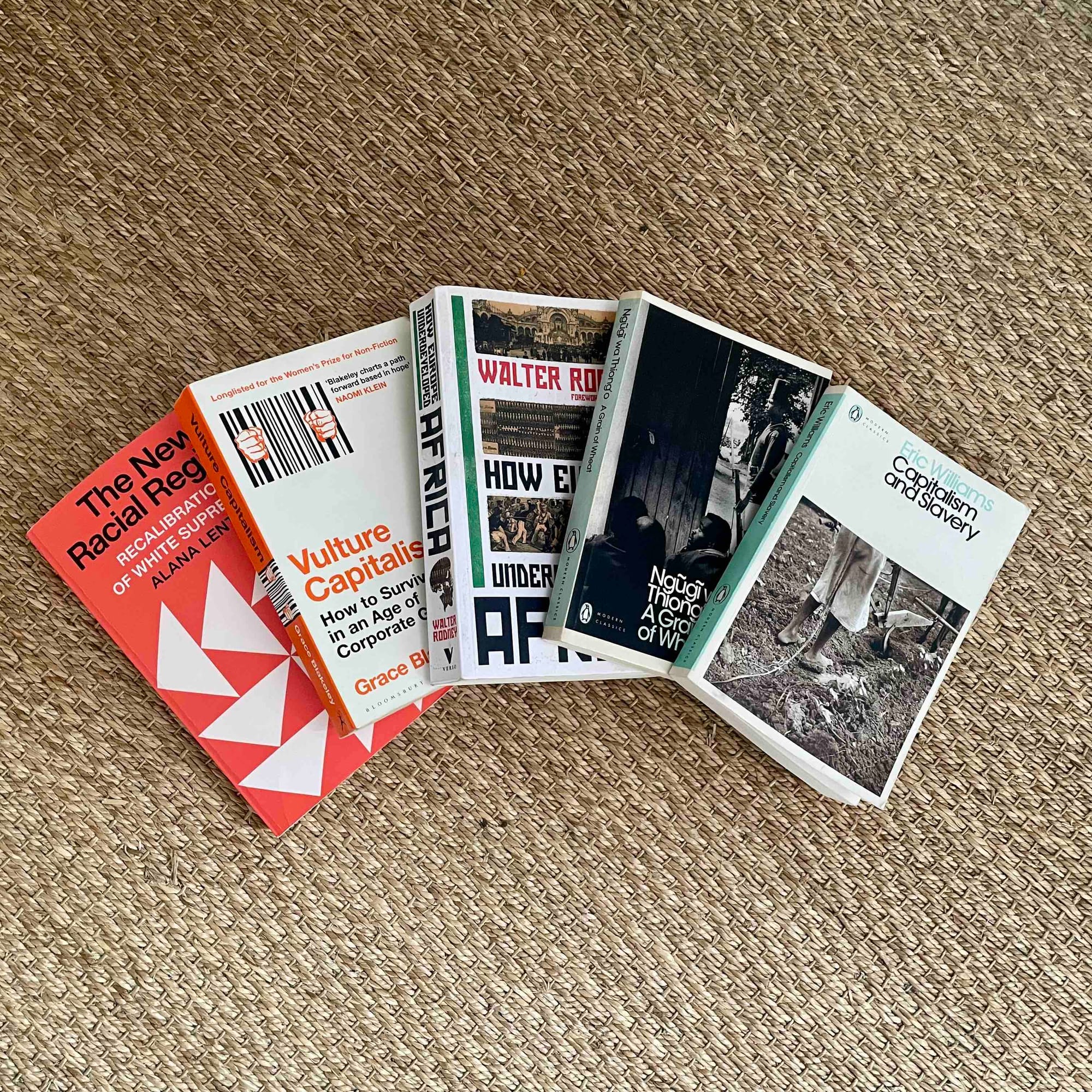


As a documentary storyteller, I read a lot around the subjects I’m documenting – nurturing what I hope is a sufficiently nuanced understanding of the complex issues I seek to document, and thereby allowing me to engage others in a constructive and meaningful way. This week I thought I would share with you some of the books I’ve been reading over the past few months, as well as those waiting patiently on my bookshelf. Before I begin, I’m always looking out for recommendations, and would love to hear about any you might have. Please comment on the post here, so more people can discover books and authors that help us understand and make sense of the people and world around us.
First a few of the non-fiction books. I’ve just finished ‘Capitalism and Slavery’ by Eric Williams, which is why you will have seen it referenced in the past couple of articles. This is one of those books everyone should read if they want to gain some insight into the truth about why the world is in the state it’s in – as are most of the ones that follow. It gives such incredible insight as to how and why the transatlantic slave trade came into existence, how it was maintained, and how and why it came to be abolished (spoiler alert: it was rooted in capitalist interests and not so much about humanitarianism).
Williams shows how capitalism evolved during this period, as the slave trade contributed to the birth of the industrial revolution in England, with the profits from the trade catalysing its growth. Despite the efforts of the planter-merchant class to maintain the existing system, gone were the days of mercantilist and agrarian capitalism. One of the many things the book highlights for me is that the capitalist class – much like the merchant class was before it – and the political class have been two sides of the same coin since capitalism’s birth. They have always been undermining democracy – blocking legislation that does not serve them, and pushing that which does. The abolition of the slave trade being a prime example of the consequences of this: initially, the capitalist class, embedded in the government, supported the slave trade and blocked abolition; later, they supported abolition when the slave trade – and the monopolies given to the planter-merchants of the colonies – hindered growth and ‘free trade’. They concluded that abolition was the right thing to do – not for humanitarian reasons, but because it made economic sense to them at that time.
I tend to read a few books back-to-back around a similar topic, so as to reinforce and build upon the knowledge gained from the previous book. Prior to ‘Capitalism and Slavery’, I was reading Frantz Fanon’s ‘The Wretched of the Earth’, Walter Rodney’s ‘How Europe Underdeveloped Africa’, as well as Grace Blakeley’s ‘Vulture Capitalism’, and Lenin’s ‘Imperialism: The highest Stage of Capitalism’. Fanon’s and Lenin’s books are classics, and are essential reading for anyone who wants to understand the history and impact of colonialism and imperialism respectively. But Rodney’s and Blakeley’s books are the kind I would buy, and indeed have bought, for others. They are incredibly comprehensive and wide-reaching, and help you glimpse behind the facade of this heavily engineered and curated world we live in. These are the kinds of books that stay with you and expand your understanding of the very fabric of the world around us.
Rodney’s book begins by exploring the development of the African nations prior to the transatlantic slave trade sapping the continent of millions of its people – resulting in it having roughly half the population it would otherwise have had. The social impact of this – the consequences of which still resonate into the present day – cannot be overstated. Rodney then goes on to explore how, through imperialism and colonial rule, and the resulting extraction of the continent’s resources, Africa played a key role in the capitalist development of Europe – how the African economies were distorted to serve the Europeans, how the surplus produced was extracted and expatriated to the colonial powers, and how the population was purposefully kept on its knees through exclusion from education, and through social, political and economic disempowerment, in order to create a subordinate people to serve the colonial powers. It’s a powerful book that’s vital for anyone who wants to understand the consequences of imperialism and colonialism on Africa and its people, which, due to a lack of truth, reconciliation and reparations, continues to be felt profoundly to this day.
To take a short break from learning about all that’s wrong with the world, I read ‘A Brief History of Intelligence’ by Max S. Bennett, which is a fascinating book about the evolution of the brain. It maps that evolution from the advent of life to the present day, and explores five key breakthroughs and the cause and effect of these on the development of life, communication and culture. I also read Benjamin Labatut’s ‘When We Cease to Understand the World’, which I devoured in a couple of days. It’s historical fiction about a handful of scientists whose discoveries empower violent societies to reach new levels of violence and destruction. So, maybe that break was shorter than I had intended!
I’m currently reading ‘The New Racial Regime: Recalibrations of White Supremacy’ by Alana Lentin, which I heard about from Pluto Press’ podcast Radicals in Conversation. I’m just coming to the end of the introduction, and having underlined so much of it, I already know my mind is going to be well and truly expanded by every chapter. It explores how the white supremacy that permeates the systems of the west is in a perpetual process of recalibration – which it does in part through distorting and undermining the language used to challenge it – in response to resistance from the people and cultures it seeks to dominate and suppress or eradicate.
I’m also reading ‘Goliath’s Curse: The History and Future of Societal Collapse’ by Luke Kemp, which I came across via Rachel Donald’s Planet Critical podcast. I just finished the first chapter this morning, and, much to her delight, I felt compelled to engage my partner on it first thing. At least I had the decency to do so only after she had drunk her morning tea!
I have a couple of audiobooks on the go as well – both of which I’m really enjoying, and know I will want to read eventually and make a copious amount of notes on: Ash Sakar’s ‘Minority Rule: Adventures in the Culture War’, which I came across due to having Novara Media as one of my key information sources on what’s going on in the world. The other is ‘Progress: A History of Humanity’s Worst Idea’ by Samuel Miller McDonald, which I came across thanks once again to Planet Critical.
I tend to read non-fiction during the day, and then fiction at night while in bed. I can highly recommend ‘Things Fall Apart’ by Chinua Achebe and ‘A Grain of Wheat’ by Ngũgĩ wa Thiong’o. These are brilliantly written, and offer insight into the experiences of living under (settler) colonialism – Achebe when it first began in Nigeria, and Ngũgĩ when it was coming to an end in Kenya, in the wake of the Mau Mau uprising. Both do so in an engaging and absorbing way that just can’t be achieved in non-fiction – the many layers of the lived experience, and the weaving of different aspects of colonialism into the evolution of the characters and their communities as they struggled with its impacts. I also read Kurt Vonnegut’s ‘Slaughterhouse Five’, which in its own right is an engaging read full of humour, but when you learn about the story behind it – how it’s semi-autobiographical – then you understand and appreciate the dark humour through a different lens.
The list of books I’d like to read is endless, but some of those already bought and sitting on the bookshelf are Timothy Snyder’s ‘On Freedom’, and ‘Selections from the Prison Notebooks’ by Antonio Gramsci – whose name comes up more and more in what I listen to and read, and who I’ve not yet had the pleasure of exploring. Then there’s Charles C. Mann’s ‘1491: The Americas before Columbus’. I read his book ‘The Wizard and the Prophet’ many years ago, which explores differing perspectives on the means by which we can most effectively build a sustainable food system. Mann is a fantastic writer, and can distill a complex and layered topic masterfully. Also sitting there waiting for me to turn that first page is ‘The Dawn of Everything: A New History of Humanity’ by David Graeber and David Wengrow, ‘The Myth of Capitalism: Monopolies and the Death of Competition’ by Jonathan Tepper, and ‘Born in Blackness: Africa, Africans, and the Making of the Modern World, 1471 to the Second World War’ by Howard W. French.
One book that I’ve yet to buy, but is now on the top of my list is ‘Black Marxism: The Making of the Black Radical Tradition’ by Cedric J Robinson. This has been referenced extensively in ‘The New Racial Regime’, with one of the central arguments made being that racism dates back to feudal times. This expands upon – or modifies even – one of Williams’ theses that the people of Africa were racialised by those benefiting from the slave trade as a means of justifying its continuation. Robinson highlights that racialisation was already a tool forged by the Europeans prior to the transatlantic slave trade – the treatment of Irish people being one such example.
What have you read recently that you feel compelled to share and discuss with others?