


Listen 🎧
You can also listen here:


Watch 📺
When the Bank of England raises interest rates, a bank does not have to do anything to make more money. What it charges on mortgages, loans and overdrafts goes up on its own. And separately from that, the Bank of England pays interest to private banks on the reserves they are required to hold with it – a cost that is ultimately carried by the Treasury.
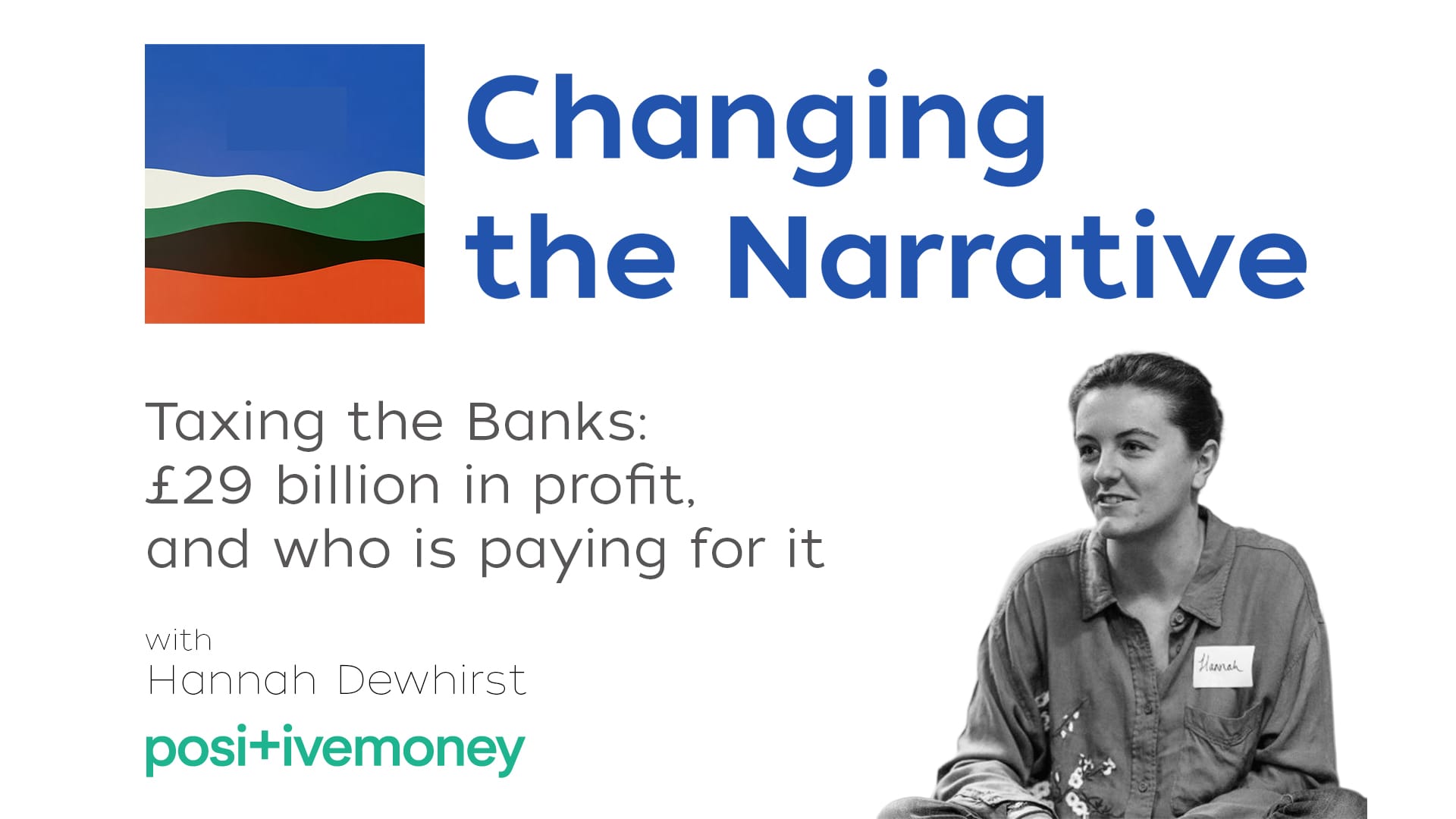
That is the argument Hannah Dewhirst makes in this episode: the record profits Britain's four biggest banks reported this summer were not earned by doing anything differently, and the public is on the other side of the ledger. Positive Money wants a 38% tax on the profits the banks make from the UK public – domestic profits only, not international or investment banking, which takes the competitiveness objection off the table before it is made.
Underneath the campaign sits the thing she says matters more: banks create new money every time they make a loan, which means they, not the government, decide where money in the economy goes. When Positive Money put that to MPs in a poll published in 2017, 85% of them did not know it. We get into what that power has done to housing, who actually gets the meetings at the Treasury, what a public digital pound would look like in your hand, and why a windfall tax is the short-term fix rather than the cure.
In this episode
- Why Britain's four biggest banks made record profits from rising interest rates without changing anything they do
- The interest the Bank of England pays on the reserves banks are required to hold, and why the Treasury carries that cost
- Margaret Thatcher's 1981 windfall tax on the banks, and why Positive Money reaches for it as the precedent
- What a 38% tax on domestically earned bank profits would cover, and what it deliberately leaves alone
- The point underneath the campaign: banks create new money every time they lend, and so decide where money in the economy goes
- How mortgage deregulation turned homes into financial assets, and what happened to social housing alongside it
- Who gets the meetings at the Treasury, and how working in coalition changes the odds
- Cheshire East, where 21 residents were brought together to write cost-of-living policy and the council adopted most of it
- The public digital pound: what a Citizens Bank of England card would mean, and where Visa, Mastercard and Trump come into it
- Why interest rates are the wrong tool for inflation driven by fossil fuels and climate breakdown
About the guest
Hannah Dewhirst is Head of Campaigns and Communications at Positive Money, the UK research and campaign group founded in 2010 in response to the global financial crisis. She studied economics as an undergraduate at Oxford, and says it was joining the Post-Crash Economics Society in Manchester, part of the Rethinking Economics movement, that introduced her to the analysis mainstream teaching had left out. She went on to work for Rethinking Economics, first joined Positive Money after moving to London, spent the pandemic at Every Doctor, and returned to Positive Money, where she now oversees its public campaigning: the supporter network, the petitions, and the stunts outside the Bank of England.
Links mentioned in this episode
- Positive Money (London, UK), the research and campaign group Hannah works for
- The campaign to tax the banks: Positive Money's call for a 38% windfall tax, which puts the big four's combined first-half 2026 profits at £29.2bn
- Banking on Property (2022), the report on how housing was turned into a financial asset
- The Power of Big Finance (2022), on the financial sector's influence over UK policy, and the analysis of who gets the meetings at the Treasury
- The poll of MPs in which 85% did not know where money comes from
- The People's Panel on the Cost of Living, run with Cheshire East Council (England) in 2022
- Greening the Bank of England's Collateral Framework, the work behind this year's win on collateral
Chapters
- 00:00 – Cold open: what MPs don't know about money
- 00:45 – Welcome to Changing the Narrative
- 01:06 – £29 billion in bank profits and the call to tax them
- 02:31 – Hannah's route into money and economics
- 04:27 – Growing public awareness that the system is broken
- 05:19 – Can the system actually be changed?
- 06:00 – Countering the power of billionaires and vested interests
- 07:20 – Positive Money in the UK, Europe and internationally
- 08:46 – What Positive Money does: the core work areas
- 10:53 – Green central banking and the collateral framework
- 13:50 – Are the institutions receptive?
- 15:16 – Hopes and concerns about the new UK government
- 16:36 – Why decisions about money are never politically neutral
- 19:11 – Policymakers who benefit from the system
- 21:24 – Working in coalition with other organisations
- 23:42 – The Cheshire East citizens' assembly on the cost of living
- 26:30 – Would the Bank of England ever run a citizens' assembly?
- 28:53 – Politicians disconnected from the people they represent
- 30:07 – What the assembly achieved, and why it hasn't been repeated
- 31:35 – Insider and outsider influencing versus the finance lobby
- 34:10 – The press, the status quo, and getting coverage
- 37:37 – Tax the Banks: how the windfall profits came about
- 41:25 – Will the Chancellor act on it?
- 43:45 – What every MP should understand about money
- 45:48 – Why banks make bad lending decisions
- 47:28 – The public digital pound explained
- 50:13 – Trump, Visa/Mastercard and financial sovereignty
- 53:32 – Who Positive Money reaches, and who it doesn't
- 56:04 – One thing to take away
- 56:45 – Closing